
Showing posts with label Software. Show all posts
Showing posts with label Software. Show all posts
Anti-virus software has
become a standard tool for keeping your computer secure and working properly.
It’s up to you to decide which anti-virus program is right for you, but keep
one thing in mind while choosing: you can always change your mind.
The biggest names in
anti-virus software offer several pricing options, including one-time purchases
and subscription plans. But if you think you’re stuck with a program that’s no
longer working for you, think again.
Here are some situations
to consider when evaluating anti-virus software:
Detection Capabilities
Tens of thousands of new
threats and viruses come online every day and your anti-virus software needs to
be able to identify all of them as they do. Some programs can detect every
threat, while others constantly look for them; your program should do both.
If you’re not sure how
many threats your software detects, run it through an anti-virus comparative
tool; the higher the score, the more current and potential threats your
software is able to spot. But since new threats appear all the time, your
program should also run frequent updates every day so it doesn’t miss
anything.
Performance Speed
If you want to hire any
local addiction rehab centers, you want to go with the most reliable center but also the
most cost efficient. The same is true for anti-virus software, and if your
program is slowing you down, a change is in order.
When anti-virus software
is scanning your computer or making updates, it uses a certain amount of
computer resources, which can slow down your processing speed. You can mitigate
this by scheduling these tasks for down times. If this isn’t an option, however,
it may be time to switch your current program for a faster-running product.
Ease of Use
Your anti-virus software
should run seamlessly without significant upkeep on your part. The best
software is easy to use and requires minimal maintenance and management, but
you might want to change your software if you find it more troublesome than
convenient.
 Is your current solution
hard to manage? Do you constantly have to consult a Help screen, or call a
support line to learn how to do the most basic things? Are you able to get the
support you need quickly and easily? If you constantly deal with any of these
issues, replacing your software with a more customer-friendly solution can save
you time and improve computer security.
Is your current solution
hard to manage? Do you constantly have to consult a Help screen, or call a
support line to learn how to do the most basic things? Are you able to get the
support you need quickly and easily? If you constantly deal with any of these
issues, replacing your software with a more customer-friendly solution can save
you time and improve computer security.
Not all anti-virus
software programs are created equal, and the right solution for one person may
not fit someone else’s needs. If your software isn’t meeting your expectations,
don’t give up; just uninstall it and look for something that delivers the best
performance for you.

The best softwares for learning
German are need to possess certain features that make learning to speak German
a walk in the park. The following are some key features that you must look for
in your German learning software:
Functionality
Ease of & Installation
& Use
The best softwares for learning
German should be intuitive and simple to use, as well as install.
Feature Set
The program should have a
step-by-step progress path for enhancing the learner’s German skills. It should
have exercises for each of the following levels.
Learning Levels
Beginner
This term refers to anyone just
starting to learn the German language. A beginner should be able to identify
spoken German and understand occasional words, but cannot converse in German.
Intermediate
This level refers to anyone who
has some exposure to the German language through high school courses, a
German-speaking friend or family member or through a short stay in a German
speaking community.
Advanced Features
This term refers to those who
have a firm grasp of the German language. Advanced students have made an
in-depth study German and have honed their command of the German language. An
advanced student can communicate easily, with confidence in everyday
situations.
Speech Recognition
Technology that recognizes
evaluates and corrects your German language pronunciation. This feature can
pinpoint mispronounced words within sentences
Training & Tutoring
Listening Comprehension
Helps you judge how well you
understand phrases, conversations and German verbiage.
Reading
Allows you to develop your
German reading skills using newspapers, cartoons and other authentic German
paraphernalia.
Writing
Allows you to type in German
and can correct and evaluate your writing skills. High-end Learn German
software offers fast, easy ways to include German accent marks in your writing.
Conversation Practice
Allows you to communicate
directly with a German speaker-real or computer simulated-through the Internet
or by other methods.
Record Playback and Compare
Allows you to take online tests
and compare your results.
• Word Processing Converter: Allows you to type a word or
phrase in either German or English, and the term is then translated into the
opposite language.
• Word and Root Search: A search tool that allows you to look
up conjugated verbs.
• Glossary: An alphabetical listing of German words with
meanings or interpretations in a various contexts.
• Dictionary: A tool that defines German terms. Words are
arranged in alphabetical order with spelling, pronunciation, and meaning
alongside. Bi-lingual dictionaries provide cross-translations-English to German
or German to English.
Support
• Phone Support: Offers a helpline with knowledgeable staff
to answer queries or troubleshoot.
• Manual: Comes with instruction manual with details for each
section of software.
• Knowledge Base: Provides a user-community oriented
knowledge base with forums etc.
• Online: Enables troubleshooting interaction through emails
with tech-support team.
The following are some of the
best softwares in the market for learning German:
Tell Me More German
The software’s intelligent
analytics engine provides a great platform for learning the German language.
Also, it has a professional appearance and navigation system, and a beginner
will appreciate the Guided Mode, which leads language learners step by step
through the process.
German Complete Edition
One of the most creative
applications, you can build your vocabulary with a three step flash card system
which includes “Preview it,” “Recognize it” and “Produce it.” Apply the
vocabulary you have learned in reading and writing, along with recording your
voice to see how well you speak compared to a native speaker. Additionally,
there are games to give you a break but continue to keep your mind working.
Rosetta Stone
Rosetta Stone German by
Fairfield Language Technologies is an amusing tool to master the German
language. The core of this program is word and image association, which is a
powerful teaching method. Within the program, you can either type in the word
letter by letter, or for long phrases you can select words from a list. It also
gives you the option of either being strict or lenient when it comes to judging
your writing attempts.
Instant Immersion German
This is your pick if your
favorite learning style is playing games. The material is presented with five
CDs, and each program offers you your choice of several German language games.
The Talk Now CD is designed for
beginners and uses a series of games to introduce you to essential German
vocabulary, and allows you to record your own voice to listen to your German.
World Talk German focuses on listening comprehension, and provides you with
several stories to help you better understand pronunciation. Talk More German
provides you with broadcast video material, several quizzes and tests so you
can track how your German is progressing.
TeachMe! German
The application from LinguaShop
is a quality program to learn the basic grammar. Before each lesson, the
program clearly explains the grammar involved in that lesson. Additionally, it
includes a book and audio CD to assist learning. It is most effective for
vocabulary needs.
Unforgettable Languages German
This software is a simple
4-disc set, flashcard based Germany language program. You’ll see clever little
phrases to help remember each German word, and after each segment is complete,
the program increases the difficulty by giving you the English word and
requiring you to give the German translation. Additionally, the program also
pronounces each German word, and addresses spelling and basic German grammar.

Data commonly appears in
plain text or clear text form. For a number of reasons, it sometimes becomes
necessary to hide or disguise the data. During such circumstances, people
choose to encrypt the information to protect it from hackers and other
unauthorized users. Encrypted data is unreadable as the process of encryption
converts the clear text into cipher text hence preserving the integrity of the
file. Data encryption is typically performed by businesses and corporations who
have sensitive data to store and protect against unintended recipients.
How it Works
The
way in which data encryption is achieved is the sender provides a password to
the intended user in a discrete email or via a secured phone line. When the
user obtains the encrypted data, he/she will have to use the provided password
to decipher the code back to its normal clear text form.
To
encrypt and decrypt covert messages, one must use the method of cryptography.
It employs mathematics to store sensitive data. A computer user can transfer
the coded data through an unsecured connection without worrying that the
content will be compromised. A scientific formula known as "cryptographic
algorithm" runs in combination with a code, which can be either a number
combination or a phrase, to encrypt the data. The plain text can be converted
into cipher text using various keys. Employing a dynamic cryptographic formula
and keeping the password in secrecy are imperative steps for the entire process
to work.
Types of Encryption
There
are different types of encryption. The ubiquitous browser and email encryptions
are the most usual types. Browsers automatically hide information through a
secure server. The encrypted domain has the traceable address starting with
HTTPS, with the "S" connoting secure. The server then decodes the information
when it arrives. For emails, the function of PGP is the normal encryption
chosen. This hides private messages, sensitive documents, and folders.
Encrypting
a hard drive is another common form of encryption. This maintains the security
and integrity of sensitive information. Comprehensive hard disk drive
encryption, restriction of user operator encryptions, and creation of an
individual encrypted virtual drive that solely constitutes of hidden data are
the three techniques for encrypting a hard drive.
Why Encryption?

Encryption
has long been performed by government agencies and military forces to carry out
covert communication. Today, it is also used by civilians and commercial groups
to facilitate data security. In previous years, there have been multitude
reports of sensitive information like client's personal records being accessed
and used via lost ot stolen laptops or external hard drives. By encrypting data
stored in your computer, you are protecting yourself in case tactile security
protocols are unsuccessful. Another good example of encrypting data at rest is
that of Digital rights management systems that avert unintended access or
reproduction of copyrighted content and safeguard programs against reverse
engineering.
Though
encryption can individually protect the secrecy and confidentiality of files
and documents, there are other methods still needed to achieve maximum security
for your data; for instance, a MAC, short for message authentication code,
confirmation and/or a digital signature. Keep in mind that advance hackers and
cryptographers can still access and use messages without decrypting it, usually
through specialized techniques and software like Tempest and Trojan Horse.

Throughout the years
technology has continued to advance and has become an integral part of our
everyday lives. Take, for example, the release of the first laptop by IBM in
April of 1981. The original laptop weighed in at a whopping 24.5 pounds. Compare that to the average laptop today, which weighs approximately five
pounds. Advances in technology have gone far beyond lightening the weight of a
laptop; they have also made software programs more accessible. Gone are the
days when people had to rely on large floppy disks to save and transfer work.
Today are the days in which you can type and email a document without ever
having to close Microsoft word.
Beyond
personal use, software also impacts many different types of businesses. There
are even some programs specifically made for certain industries. Below are
three beneficial and useful types of software business owners can utilize as
Point of Sale Software
This
type of software is primarily used in the retail and food service industries.
It allows stores and restaurants to keep track of their inventory. It also
allows them to pinpoint products that seem to be selling exceptionally well as
well as those that are under performing. Many companies offer this type of
software, with a little digging you may even find a free download of it.
Accounting Software
Accounting
is an important part of business, regardless of the specific industry. Business
owners and managers use accounting to create financial reports and review the
efficiency of their operations. With this information, business owners can make
decisions and find ways to improve their company's profitability.
Also,
with tax season here, it may also be a good idea to invest in some tax
preparation software. Companies like Turbo Tax offer solutions that can be
tailored for both personal and business needs. Keeping the books straight and
the staff paid will help businesses, both large and small, succeed.
Shipping Software
Many
companies today rely on a variety of delivery services to ensure their clients
receive their products and services on time. One of the most important
aspects of customer service is having an organized shipping department.
Purchasing shipping software solutions may help
alleviate the stress of keeping outgoing products organized. Like many others
this software can be tailored to fit the business and industry the user is
involved with.
As
technology continue to advance, it's important that business owners take
advantage of the tools available to help their business grow and prosper.

As a
small business it can often be hard to get ahead of the game, for many people
the lack of financial support and resources means it can often be difficult to
compete with the “big guns” or even offer the same kind of service that they
can and as such it can leave you with a very small niche in the marketplace.
The
development of technology has brought about a number of benefits to smaller
businesses, but in general it allows them to offer a higher level of customer
service to their clients with a reduced number of staff – and most importantly
a reduced expenditure – and as such it makes software an incredibly popular
option for small businesses.
Why is software development an important addition to my
business?
At the
end of the day, software development can play a very important role in the way
that your business operates and if you are looking to get ahead by offering a
great level of customer service then this type of development can very well
play an important role in doing this.
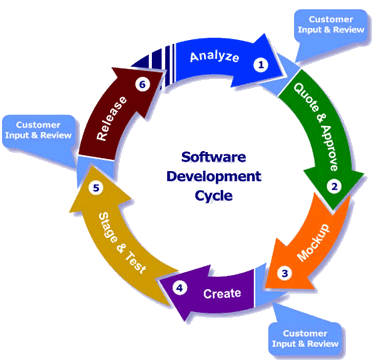
In a
world where we are becoming quickly dependent on software it’s not hard to see
why it’s important that each business has software which really keeps it on top
of its game, and if you are a small business then you will want the most up to
date software, helping to benefit your customers and reap financial rewards for
your business.
Can software development benefit a small business?
Absolutely,
the great thing about software development is that it can only benefit your
business and while you might have to make a little expenditure initially on the
software, with a bit of luck you will make this money back easily over time.
Companies
often shy away from the somewhat expensive set up of software initially, but if
you can get over this stage it’s easy to embrace it and as a result you could
really find that effective software development can genuinely reap rewards for
your business and ensure that you are able to really benefit from it further
on.

Where did the terms computer bug and debugged come from? On September 9th, 1947 a woman, Grace Hopper, was working on a computer at Harvard University. The computer was one if those main frame computers that were very large. It was called the Mark II Aiken Relay Computer. When the computer stopped working, she began to investigate the problem. After removing one of the panels she found a moth caught between two relay points.
When she removed the moth and put the panel back in place, the computer functioned properly again. Grace reported that the computer was debugged. The terms computer bug and debugged remain in use today.
Computer Virus
When she removed the moth and put the panel back in place, the computer functioned properly again. Grace reported that the computer was debugged. The terms computer bug and debugged remain in use today.
Computer Virus
Scientific American reports the history for the term "computer virus" comes from two separate origins. The first person to come up with the idea of a computer virus was John Von Newman. He wrote an article about computers being able to reproduce. The title of this paper was called "Theory and Organization of Complicated Automata".
Later, during the 1950s computer programmers at Bell Labs took Von Newman's idea and invented a computer game called "Code Wars". In this game, bits of software called "organisms" would be sent to the player's computers. The object of "code Wars" was for the organisms to gain control of the opponent's computer.
In 1986, Fred Cohen discovered the first mathematical algorithm for a computer virus. It was with this algorithm that a computer virus could be replicated. Cohen wrote his PhD thesis on this subject.
Trojan Horse
Everyone remembers the story of the Trojan horse. It comes from the ancient tale from the Trojan War. The Greeks tricked the army of Troy by making them think the Greeks had fled by way of the sea. However, the Greeks built a huge wooden horse that was hollow on the inside. Many of the Greek soldiers hid inside of the horse. When the Trojans thought they had run off the Greeks the pulled their wooden horse home to Troy as a trophy. We all know the end of that story.
The legend of the Trojan horse gave rise to the phrase being synonymous with tricking an enemy be inviting them into a safe place.
In computer language a Trojan horse is a bit if malware that seems harmless, but when introduced to a computer it causes damage to the computer's programs. The malware can completely shut down a computer and make it useless.
Software
The term software was coined in 1958 by John Tukey. Computer software is a computer program that tells a computer what to do.
Malware
Malware is malicious software that is secretly downloaded into a computer. Once downloaded, the malware can take control of your computer.
Hacker
In the early 1960s computer hackers came into being. They were mostly MIT students trying to gain entry into the main frame computers. The students warred with each other by sending computer codes to wipe out each other’s programs to gain control of their computers. Since then hackers have been getting smarter as programs become more sophisticated.
I hope you like this article, feel free to make comment (feedback)...


 Posts
Posts



